
No guarantee of success
Even carefully executed root canal treatment cannot guarantee healing in every case. Anatomical complexity, prior treatment history, and the condition of the tooth all influence prognosis.

Endodontics · Microscope
Primary root canal treatment and retreatment under a dental microscope. Rubber dam isolation, NiTi rotary preparation, bioceramic sealer where indicated, photographic documentation at each step. Diagnostic-first - including CBCT when the situation requires it.
About the treatment
Endodontic treatment is performed when the pulp tissue inside a tooth is inflamed, infected, or non-vital. The goal is complete cleaning and dense obturation of the root canal system - so the natural tooth can remain functional long-term.
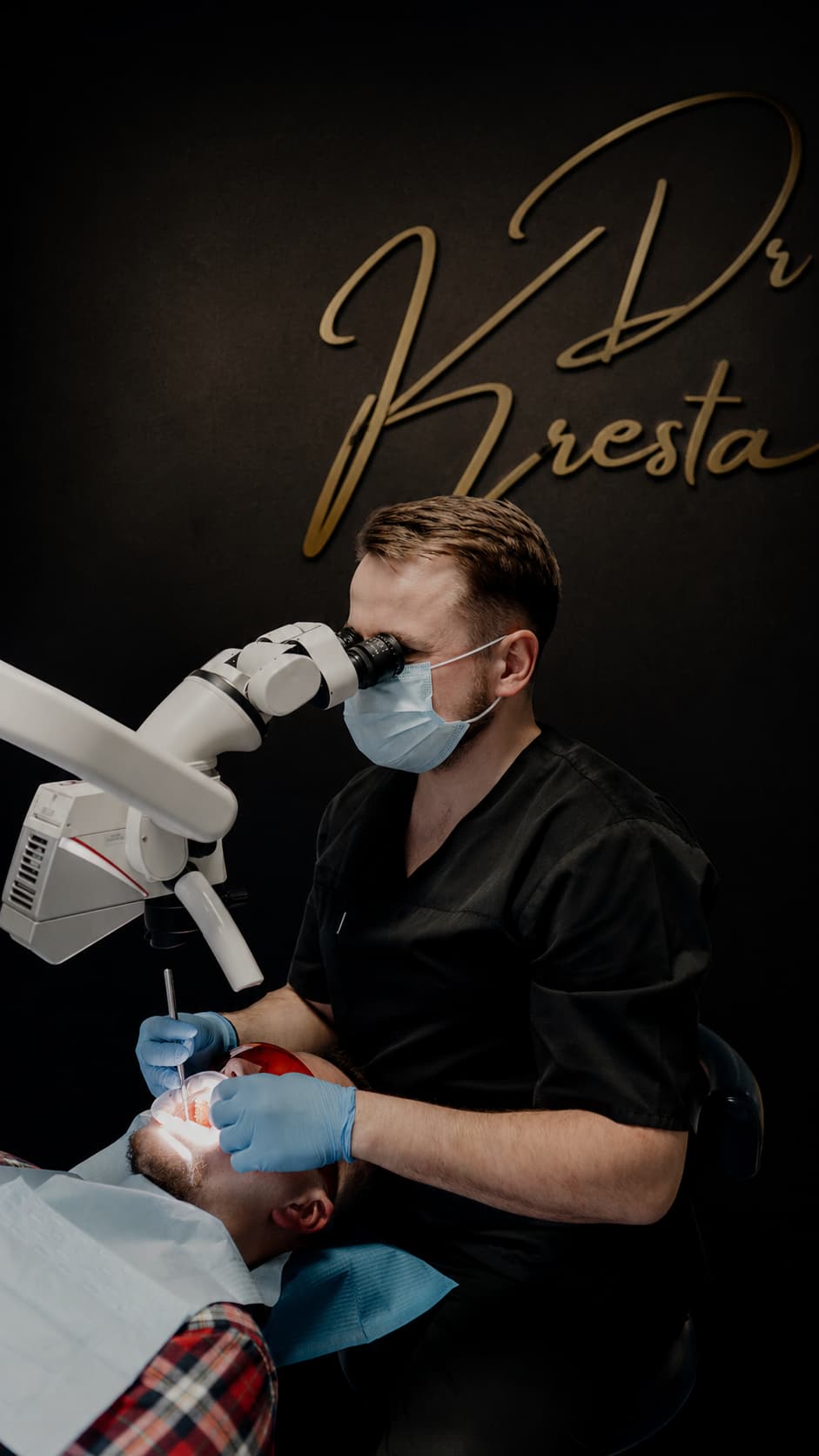
Treatment in this practice is carried out under the Leica M320 dental microscope. The microscope is not a marketing feature - it makes structures visible that cannot be seen with the naked eye: additional canal orifices, calcifications, micro-cracks, and fine anatomical branches.
In previously root-treated teeth with persistent symptoms, retreatment may be indicated. Here too, diagnostics come before the treatment plan.
What this means in practice
Working under the microscope is not about technology for its own sake. It is about better vision: canal orifices, micro-cracks, and anatomy that would otherwise go unnoticed.
Who should read this page
Endodontic treatment may be appropriate in the following clinical situations. The final decision is made after examination and diagnostic imaging - not before.
The tooth has symptoms or a known pulp injury that, without endodontic treatment, would lead to loss of the tooth.
A previously root-treated tooth continues to cause problems or shows a periapical change on imaging. Retreatment is an option in these cases.
Before a planned crown or bridge, endodontic pre-treatment of the abutment tooth is sometimes clinically indicated.
Complex anatomy, blocked canals, or calcifications where treatment under magnification can change the outcome.
How I work
Four principles that apply to every endodontic case.
01
Clinical examination, periapical X-rays, CBCT when indicated. A treatment plan is proposed only after evaluation of the full diagnostic picture.
02
Leica M320 for magnification and illumination. NiTi rotary instruments for shaping, thorough irrigation protocols throughout.
03
Rubber dam is standard on every case and non-negotiable - sterile working conditions are the foundation of a clean obturation.
04
Before, during, and after treatment. Findings, preparation, and obturation are documented; a copy goes to the patient.
Treatment process
The exact sequence is set in the individual plan. Most endodontic cases require two appointments.
01
Examination, history, X-rays or CBCT. Discussion of options, prognosis, alternatives, and the limits of treatment.
02
Local anesthesia, rubber dam isolation, access opening, working-length determination, NiTi rotary shaping, irrigation. In heavily infected cases, a medicated dressing is placed between appointments.
03
Re-irrigation and drying, dense warm-technique obturation, coronal seal. Confirmation X-ray.
04
After root canal treatment, a crown or at minimum an adhesive core buildup is usually required to protect the tooth from fracture. This is coordinated in the prosthetic plan.
Before we start
Endodontic treatment is a medical procedure. Outcomes depend on factors that cannot always be fully controlled.
Even carefully executed root canal treatment cannot guarantee healing in every case. Anatomical complexity, prior treatment history, and the condition of the tooth all influence prognosis.
Most cases require two appointments. Travel time between sessions is possible and planned individually.
A root-canal-treated tooth typically needs a crown or adhesive restoration. This follow-up work is part of the overall treatment plan.
Before treatment begins, you receive written information covering anesthesia, possible complications, and post-procedure care.
Communication
Written and verbal communication during consultations is in English or Polish. Translation tools may be used for written exchanges when helpful. English-language contact is available by form or email.
Frequently asked
Treatment is performed under local anesthesia and is generally well tolerated. Some post-procedural sensitivity is normal and usually resolves within a few days.
Contact
This page is informational and educational. It does not constitute medical advice or a binding offer. Treatment scope, suitability, and outcomes are determined individually after in-person diagnostics and clinical examination. Results cannot be guaranteed.